
Logistechs Living Lab

Logistechs Living Lab
TAMIU's Logistechs Living Lab is a dynamic innovation research facility focused on improving the efficiency and competitiveness of cross-border trade and transportation through collaborative, real-world pilot testing.
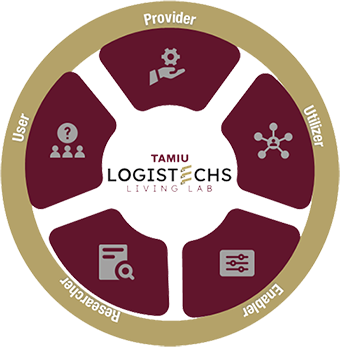
Five key actor types — Providers, Utilizers, Users, Enablers, and Researchers — work together within the lab to co-create, prototype, and validate solutions in the real-world environments where they will be deployed.
What is the Logistechs Living Lab?
The Texas A&M International University Logistechs Living Lab is a dynamic innovation network where five key actor types work together to create and test innovative solutions for real-world cross-border trade and transportation challenges.
Unlike a traditional research lab, a Living Lab operates in real-life environments — bringing together industry, government, academia, and end-users to co-create, prototype, and validate solutions in the context where they will ultimately be deployed.
Participant Roles
Explore the critical roles in the TAMIU Logistechs Living Lab — a dynamic innovation network where five actor types collaborate to create and test solutions for real-world problems.
Providers
Present the Living Lab's other actors with their product or service portfolio. They are mainly private companies that enter Living Labs to co-develop new products, services, and solutions to their own business or industry needs, focusing more on long-term results.
Utilizers
Aim to develop their businesses within the Living Lab ecosystem, mainly through short-term Living Lab cases. Their focus is on developing and testing their new products and services.
Users
Actual end-users involved in the Living Lab operations and the short-term Living Lab cases. They provide direct feedback from real-world usage, which is central to the lab's validation process.
Enablers
Public sector actors, non-governmental organizations, or financiers — such as towns, municipalities, or development organizations — that create the conditions for innovation to take place.
Researchers
Facilitate the practical implementation of pilot tests for real-world problems by bringing together their technical expertise and the consensus of all Living Lab stakeholders. Their goal is to integrate methodologically sound, innovative, and sustainable solutions.
Living Lab Workflow
A structured process designed to foster collaboration and collective intelligence among all participant roles, from identifying challenges to delivering tangible results for cross-border trade and transportation.

Problem / Challenges
Real-world cross-border trade and transportation challenges are identified and scoped by industry and community partners.

Collective Intelligence
Researchers integrate technical expertise with stakeholder consensus to design methodologically sound pilot tests and solutions.

Solutions / Results
Validated, innovative solutions are delivered that drive sustainable growth and operational improvements in the border region.
Thematic Framework
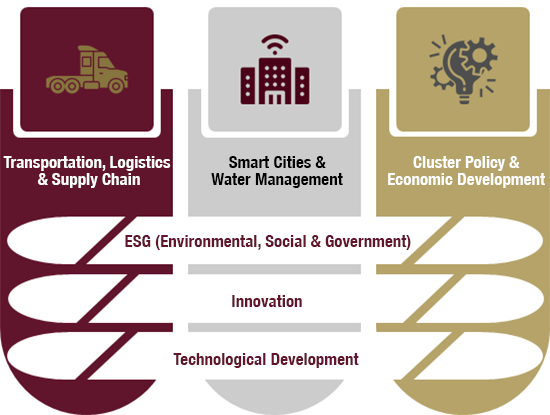
The Logistechs Living Lab focuses on three key thematic areas, each examined through three transversal lenses that ensure all work is sustainable, innovative, and technologically forward-looking.
Transportation, Logistics & Supply Chain
Improving the efficiency, security, and competitiveness of cross-border freight movement — from trailer interchange to customs processes and last-mile delivery.
Smart Cities & Water Management
Leveraging data and technology to create more efficient, livable, and resilient border communities — including infrastructure, public services, and environmental sustainability.
Cluster Policy & Economic Development
Strengthening regional economic clusters and policy frameworks that support border business competitiveness, international trade, and cross-border enterprise development.
Transversal Lenses applied across all focus areas:
ESG — Environmental, Social & Governance
All Logistechs Living Lab research is examined through the lens of Environmental, Social, and Governance principles. This ensures that proposed solutions contribute to sustainable border development — minimizing environmental impact, promoting social equity, and supporting sound governance frameworks for cross-border trade and transportation.
Innovation
Innovation is central to the Living Lab model. Research projects are designed to challenge existing practices and develop novel approaches to longstanding border logistics and trade challenges. By co-creating solutions with industry, government, and end-users, the lab produces outcomes that are both technically sound and practically deployable in real-world conditions.
Technological Development
Technology is a key enabler across all thematic areas. From IoT sensors and data platforms to web applications and digital infrastructure, the Living Lab actively identifies, tests, and scales technological solutions that improve the efficiency, visibility, and competitiveness of the Texas-Mexico border trade corridor.
Research Projects
Active and completed projects developed through the Logistechs Living Lab framework, spanning transportation, logistics, smart cities, and economic development.